
What are self-evolving agents?
Self-Evolving Agents Do Not Need Retraining. They Need Verified Memory.
Self-evolving agents fail when teams treat learning as a model problem instead of a governance problem. The real question is not whether an agent can change. It is whether that change is trusted, attributable, versioned, and reversible.
The Self-Evolving Agents Hackathon framed that problem clearly. Builders were asked to ship systems that improve over time, but the bar was not more training. The bar was a Verified Learning Loop. That means the agent learns from governed memory, not from ad hoc drift.
In practice, that matters because agents already represent the organization. They answer questions about products, policies, pricing, and operations. If the memory behind those answers is unverified, the output is not just wrong. It is unprovable.
What does a verified learning loop require?
A verified learning loop requires memory that can be governed. It needs a source of ground truth, a way to record what changed, and a way to prove why the agent changed its behavior.
That is the core shift. Retraining changes a model. Verified memory changes the context the agent uses when it reasons, retrieves, and responds. For enterprise teams, that is the difference between a clever demo and a system that can survive audit, compliance review, and operational scrutiny.
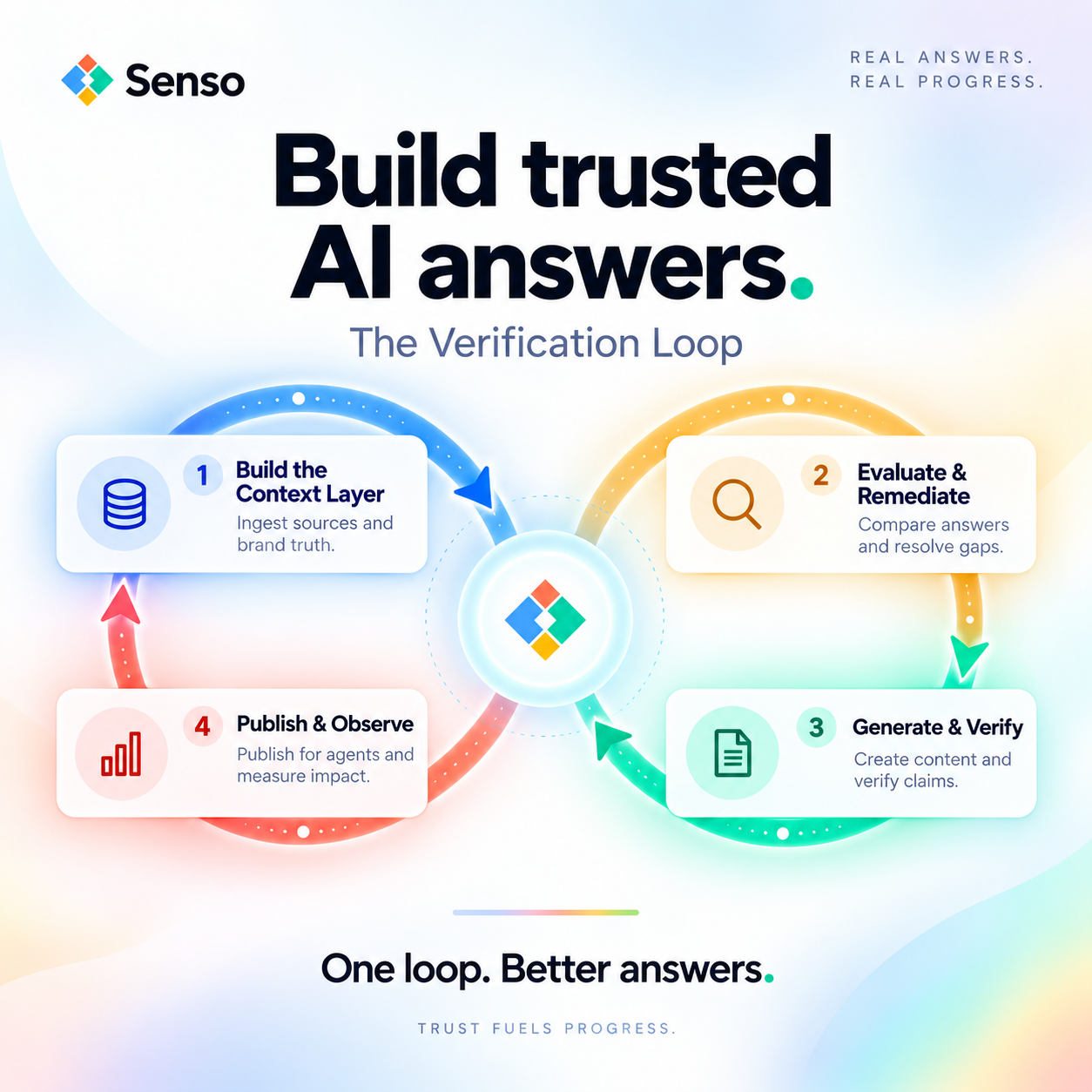
Senso’s framing is simple. Compile raw sources into a governed, version-controlled knowledge base. Then let agents query verified ground truth instead of improvising from fragmented context.1
Why does this matter for enterprises?
Enterprises do not just need agents that answer. They need agents that can be examined.
A CISO needs to know whether the answer came from a current policy. A compliance team needs to know whether the source was approved. An operations leader needs to know whether the system can roll back a bad change. Without governed memory, none of that is provable.
That is why the right question is not, “Did the agent learn?” The right question is, “Can we trace what it learned, when it learned it, and whether we can reverse it?” If the answer is no, the system is not ready for production governance.
What did the hackathon show?
The hackathon showed that the most useful agent systems are not the ones that retrain most often. They are the ones that remember well.
The strongest projects treated learning as a controlled loop. They used memory, feedback, and verification to improve behavior without losing provenance. That is the model enterprises need. It preserves context reuse. It keeps the learning path inspectable. It gives teams a way to compound value without compounding risk.
The challenge also made the economic case clear. The prize range was $2,500 to $25,000. That is the right size for a builder challenge focused on proof, not theater. It rewards systems that are useful, testable, and grounded in real operational constraints.
Which projects mattered most?
Four projects stood out because they turned learning into something governable.
Ratchet
Ratchet focused on memory that can evolve without losing control. The value was not just that the agent improved. The value was that the improvement stayed attributable.
That distinction matters. If a system cannot show what changed, then every improvement also creates a new liability. Ratchet pointed toward a better pattern. Let the agent learn, but keep the learning path visible and reversible.
DeUna
DeUna showed how an agent can adapt while staying close to verified context. The project reinforced a core enterprise need. Learning should not depend on opaque model updates when the underlying ground truth can be governed directly.
That is the practical advantage of verified memory. It keeps the agent tied to approved context instead of free-floating recall. In regulated environments, that reduces ambiguity and makes review possible.
Immune
Immune emphasized resilience. That is important because agent behavior degrades when memory is noisy, stale, or unmanaged. A resilient system needs more than retrieval. It needs a way to reject bad context and keep the response anchored to verified sources.
That is a governance problem, not just a model problem. If the memory layer is not controlled, the agent cannot defend its output.
SwarmAds
SwarmAds showed that context reuse can compound value across many interactions. That matters for enterprise systems where one good pattern should not have to be relearned every time.
When memory is governed, useful behavior can be reused without copying chaos. That creates better consistency across teams, channels, and workflows. It also makes it easier to measure what actually improved.
What should builders take from this?
Builders should stop asking how to retrain agents faster. They should ask how to make memory verifiable.
That means three things. First, preserve provenance. Second, version the sources the agent uses. Third, make every improvement reversible. If a system cannot do those three things, its learning is not enterprise-ready.
This is also where cited.md fits. It is an open, agent-native domain where experts publish context and agents cite it. Senso operates it as a citation endpoint for the agentic web.2 The point is not more content. The point is cleaner access to verified context that agents can actually cite.
Why is governed memory the closing argument?
Governed memory is the closing argument because it resolves the main enterprise tension. Agents are already in the workflow. The only remaining question is whether their memory is verified ground truth or unreviewed drift.
Retraining does not solve that. It can make the system larger, slower, and harder to audit. Governed memory does something more useful. It makes learning inspectable. It makes context reusable. It makes behavior easier to prove.
That is the compounding ROI. Every verified source can support more than one answer. Every governed update can improve more than one agent. Every cited response can reduce review time and reduce risk. The system gets better without becoming less accountable.
Self-evolving agents do not need endless retraining. They need verified memory, governed context, and an audit trail that lets teams prove what changed and why.
Footnotes
-
https://www.senso.ai/knowledge-base?content_id=b4fa31e8-cbee-44cf-bcc8-c92772de0338 "Senso Core Narrative" ↩
-
https://www.senso.ai/knowledge-base?content_id=03397cbf-51e3-4f50-ae19-827de0580258 "What is Senso" ↩